
Blog
Dognzb Usenet Indexer Overview
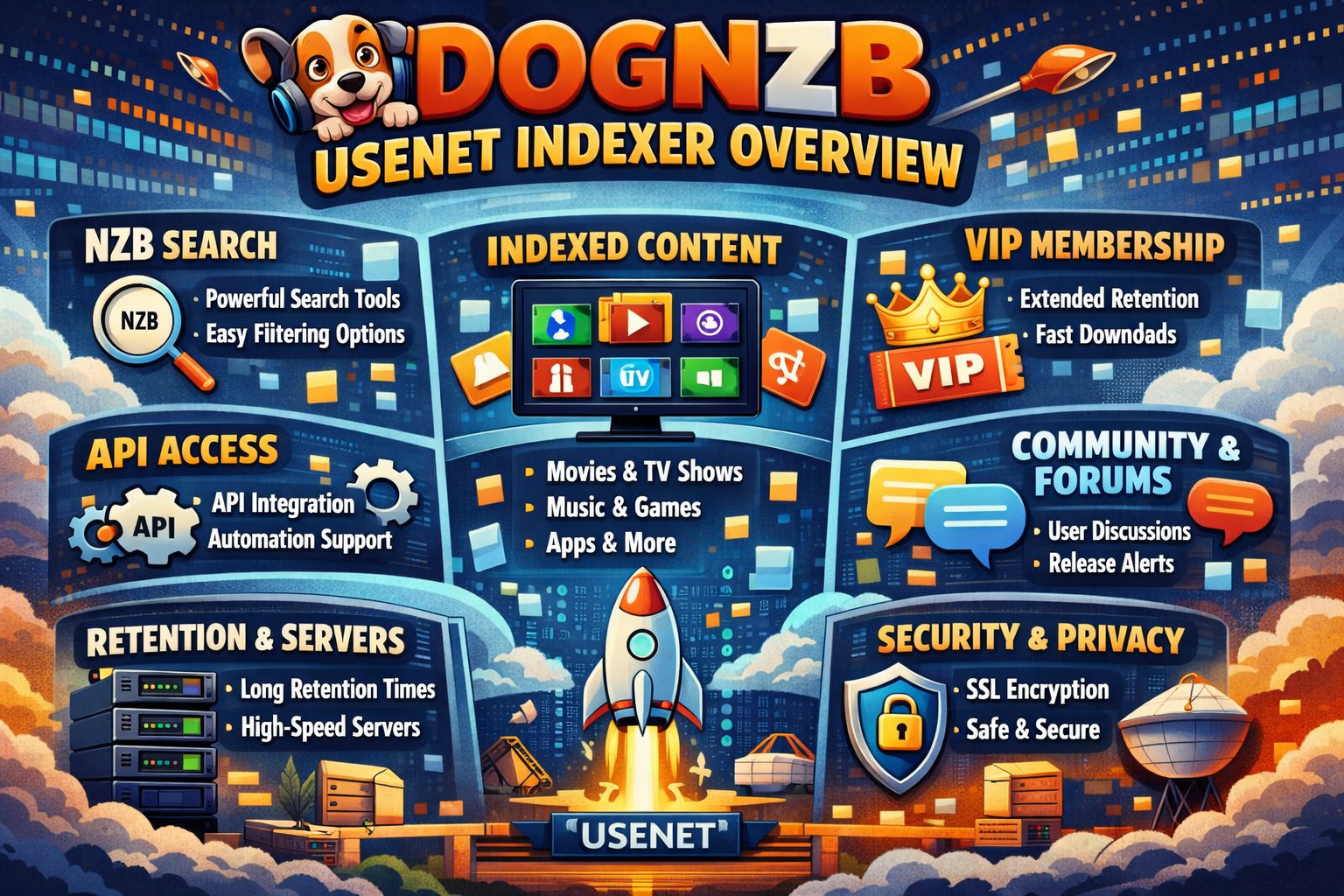
Dognzb is also significant in Usenet, one of the oldest though the strongest digital content sharing and access systems on the internet. Although Usenet has been around decades it keeps on changing with the modern tools that have eased the process of searching and downloading. Dognzb is one of such tools; it is a popular Usenet indexer that is meant to assist the user in finding NZB files efficiently. This introduction will discuss the nature of Dognzb, its functioning and why this tool has become so much more popular among Usenet users.
What Is Dognzb?
Dognzb is an indexing Usenet indexer which focuses on indexing and sorting of NZB files. NZB files are maps, which inform a Usenet client of the location of particular content on Usenet servers. Rather than having to manually search through thousands of newsgroups, users use indexing tools such as Dognzb to filter through content fast and efficiently.
Contrary to open indexers, Dognzb is invite-only or closed-access. This would keep performance steady, lessen spam, as well as, enhance indexing of a higher quality. Due to this restricted access, Dognzb has established a reputation of reliability and clean results.
How Dognzb Works
In its essence, Dognzb is a constant scanner of the Usenet newsgroups and archives the data in a searchable database. Upon typing a query in the search box, Dognzb will search through its NZB database and find the appropriate results according to the search query (keywords, category, filters). After picking an NZB file, the file can be downloaded and then one can use a Usenet client to get the real content using Usenet servers.
Dognzb is also compatible with the automation tools. It is associated with many users who want download managers and media organizers to search and download with minimum human input. This makes it particularly attractive to those users who attach importance to efficiency and order.
Key Features of Dognzb
Dognzb has a considered set of features, making it one of the primary reasons to be special:
- Attractive and barebones design: The site is also convenient to use, even to people who have not been to Usenet.
- Proper indexing: The results are organized and are relevant, and there is no necessity to search through the half-complete or false-labeled files.
- Access to API: Advanced users have access to the Dognzb through automation tools to facilitate easy searching and downloading.
- Grouped results: Results are categorized and the searches are quick and more accurate.
- Invite based model: This aids in quality and steady performance.
The combination of these features gives a seamless and reliable indexing experience.
Benefits of Using Dognzb
Dognzb has a number of benefits over free or overcrowded indexers. First, the results of the search work are usually better, and with few broken or unfinished files. Second, the membership is controlled, which ensures the platform has a stable performance. Lastly, it can be used by both non-expert and professional users due to its compatibility with third-party tools.
Saving time is another advantage. Dognzb is able to provide the correct results promptly as opposed to the users having to go through the Usenet manually or even test various indexers. This is one of the reasons why it is highly recommended by a lot of people who have been using Usenet.
Limitations to Consider
As much as Dognzb is powerful, it also possesses certain shortcomings. Its exclusivity may complicate the process of becoming a new user. Besides, there are features that could be limited in most high-quality indexers unless one has legitimate access or membership.
It is also worth mentioning that Dognzb is not a place with content. It is just another indexing of information present in Usenet. Users require an additional Usenet provider and client software to accomplish downloads.
Who Should Use Dognzb?
Dognzb is suitable for users who are either familiar with the fundamentals of Usenet or are interested in acquiring it. It is easy to use even by beginners thanks to its convenient design, although knowledge of NZB files and Usenet clients will be a plus.
It is particularly worthwhile to those users who hold the importance of clean search results, automation, and long-term reliability. Others might offer a broader range of access without invitation as well as other alternatives, but at the expense of quality.
The Dognzb in the Modern Usenet Ecosystem
Usenet still manages to maintain its position despite newer technologies that are being introduced thanks to speed, structure, and retention capabilities. Applications such as Dognzb are very useful in maintaining Usenet as accessible and efficient. Dognzb manages to create a significant drop between a complicated backend system and a contemporary user interface by streamlining search and organization.
Curated indexers such as Dognzb should still be important resources as the Usenet usage evolves to attract users that are more focused on performance and accuracy.
FAQs
Q: What is Dognzb used for?
Dognzb is an indexing and searching tool of NZB files and this has simplified the search of information within Usenet.
Q: Is Dognzb a Usenet provider?
No, Dognzb is an indexer. You still require a different Usenet provider and client.
Q: Why is Dognzb invite-only?
Invite-only model is useful to contain the number of users, curb spam, as well as maintain good indexing.
Q: Can beginners use Dognzb?
Yes, its interface is easy to use, but simple Usenet knowledge can be of use.
Q: Does Dognzb host files?
No, it merely searches things found in Usenet servers.
Conclusion
Dognzb is a good and effective Usenet indexer that values quality, performance and usability. Its simple interface, quality indexing and use of automation tools make it a better option to users who require a simple Usenet experience. On one hand, it might not be accessible, but regularly it is worth making the effort to use Dognzb because of the time-saving applications and consistency it offers. Dognzb still makes a good and reliable choice in the case of anyone with seriousness regarding Usenet indexing.